There remains nothing left to be said about Heath Ledger's performance in The Dark Knight. His extraordinary portrayal of Batman's most iconic enemy catapulted The Joker into the most esteemed circles of cinematic villainy. His nakedly evil charisma and pragmatism drives the film, which, even in hindsight, remains one of the best Hollywood blockbusters of all-time, the most exciting of its kind since Aliens. Batman Begins, my personal favourite of the trilogy, was unexpectedly political and relevant, almost, if you excuse the slang, 'artsy'. It's highly entertaining, and the most narratively coherent of the three, but it stands as a bold metaphor of the dangers of Capitalism and currency's chokehold on human existence. It's also very moving, exploiting the obvious humanity which makes Batman so much more relatable and appealling than most other Super Heroes. It's one of my favourite films of the Noughties, along with Nolan's second film, Memento. Nolan had a difficult task on his hands to match the quality of these movies with his third, and last, Batman film. Expectations were that he should exceed them; a near-impossible task, especially given the 'Third Part Curse', which seemingly plagues every trilogy save for Toy Story, and maybe Bourne. He fails.
The Dark Knight Rises is extremely disappointing, both as a filmic finale and as a film in its own right.
Nolan uses cheap plotting tricks and twists, and it quickly becomes clear that he ran out of ideas following the first two. The storyline is predictable; if you have even the most limited knowledge of the Batman universe, you should be able to realise what's around the corner. Each twist feels forced, surprising considering Nolan's previous successes with them; the warehouse explosion scene in The Dark Knight, the final reveal in The Prestige, and, basically, the entirety of Memento. The film trundles along confusedly, unsure of what it actually is. The transition between slower moments of (sadly cliched and now overly familiar) profundity concerning self-sacrifice, vigilante-ism and grief, and (the still compelling) action sequences is awkward and jolty, with obviously important scenes being ended abruptly, and edited for the sake of ramming-speed pacing.
The dialogue, although having never been Nolan's strongest suit, is particularly dreadful, hideously contrived and warped to move the story along as quickly as possible. There is no real flow, wit or intrigue in the script, just painful one-liners and boring monologues. The new characters are one-dimensional; Bane, with so much potential, is nothing more than a stereotypical anarchist-communist, who believes chaos is good for the common man, that the rich should be pay for being rich while others are poor, and so on and so forth. Blake, the beat-cop, is too perfect, too shiny. He is the modern, and actual, personification of the Harvey Dent White Knight of Gotham myth, except Nolan chooses this flawless hero trait as the character's sole backstory, rather than manipulating and twisting it like he did in the previous film in the creation of Two Face to symbolise man's natural corruption. Catwoman, although eh... aesthetically pleasing, is completely redundant and pointless in the plot's progression. Marion Cotillard's character cannot be adequately explained without mentioning spoilers, so I'll just say this; it's rubbish.
The film has its highlights; Caine, Bale and Oldman are as excellent as ever, and Tom Hardy, despite the cumbersome dialogue, is fantastic as Bane; his unique posh-Gypsy English accent and sad distant eyes inspires fascination, while his brooding hulk of a figure provokes fear and menace. As mentioned previously, the action scenes are still exciting, although not as clever as before.
The Dark Knight Rises is by no means a terrible movie, it's certainly above average when compared with your generic contemporary action film. It just feels as if it's trying too hard; too hard to be epic, too hard to be funny, too hard to be poetic, too hard to be emotional. It all too often descends into using monotonous, by-the-book narrative pressing, corny sentiments of patriotism/heroism or heavy-handed thematic exposition. In the end it's a confused, muddled mess, with some great set pieces, and some fantastic shots of Anne Hathaway's body parts in a tight, latex costume. At least we'll always have them. The film remains a complete cop-out, pandering to the box-office's unquenchable thirst for all things bigger but not necessarily better. Maybe Nolan made it as he did to appease Warner Brothers. Maybe it's the Batman film the public needed, not the Batman film the public deserved.
Monday, 23 July 2012

Sunday, 1 July 2012
Mini Reviews #2
Same format as last time. 3 reviews, all less than, or equal to, 250
words. Enjoy.
The Counterfeiters
German cinema, and to a lesser
extent, Spanish cinema, has always been the equivalent of the under-appreciated
middle child in European film, with its intelligent, progressive, ambitious
siblings, French and Italian cinema, taking most of the plaudits. This is in
spite of Deutschland producing some of the most important and brilliant directors in film history, seemingly like clockwork; Fritz Lang, Wim Wenders,
everyone’s favourite nutcase, Werner Herzog, and more recently, Olivier
Hirschbiegel. I’d go as far as saying that it’s my third favourite country, cinematically at least,
behind British and Korean. At the risk of sounding racist, German films are efficiently
solid viewing. The Counterfeiters, a
war drama about Jews who were recruited into a Nazi counterfeiting (funnily
enough) operation tasked with destabilising the British and American economies,
continues this trend. While it never quite flirts with the promised land of
filmic greatness, it remains a well-acted, powerfully told insight into one of
World War Two’s forgotten acts of bravery. There are excellent performances
from Karl Markovics and August Diehl as two Jewish prisoners facing suitably
difficult moral dilemmas; compromise your beliefs and survive, or martyr
yourself as a hero for your cause. Devid Striesow is intriguingly complex as
the officer in charge of the operation, sort of like a less charismatic, and chubbier,
Oskar Schindler. He is utterly nonchalant about anti-semitism, and is only
concerned with his personal success. The noirish, brass-focussed score is
effective, and the ending, although predictable, is satisfying. A rewarding and
moving, if not awe-inspiring, watch.
Tyrannosaur
Tyrannosaur is
Paddy Considine’s (who I’ve met outside the Greggs on Sauchiehall Street in Glasgow by the
way. Through the medium of online journalism, it’s as good a situation as any
for name-dropping) directorial debut, and to use an English colloquialism, it
is an absolute corker. After giving one
of my all-time favourite performances in Dead
Man’s Shoes, one of the most disturbing and gut-wrenching films ever made,
Considine proves here that he has just as much ability behind the camera as in
front of it. His camerawork in portraying working class England is, inevitably,
reminiscent of his mentor Shane Meadows, but it works effortlessly in the development of the appropriately depressing setting,
and the quality of his writing is perhaps, although not as funny, even better
than his aforementioned tutor. Eddie Marsan, is back at his best here, playing,
yet again, a creepy, sad, terrifying little man. He plays this role so often
that I’m beginning to think he might well be a creepy, sad, terrifying little
man... Peter Mullan, a consistently excellent actor and faithful Celtic
season-ticket holder, is even better. His heavy Glaswegian accent emphasises
his abhorrence, anger and bitterness towards everyone and everything and it is
terrifying to behold, yet the warmth he occasionally shows also incites in him
a deeply sympathetic character. The highlight however is Olivia Colman. No
superlative can adequately describe her. Very probably the best performance
by an actress I’ve seen. Just watch her. She is quite literally jaw-dropping. A
free hug for whoever spots the Celtic scarf Easter egg.
Ironclad
Ironclad can be summed up very simply and easily. It’s really,
really terrible. But it’s also very, very violent. Which, when I assume the
adolescent, testosteroney version of myself, (the same badass version who takes
criminal delight in driving through red lights in Grand Theft Auto IV, and killing spiders in the house without shedding
a single tear out of overwhelming fear which has clearly, obviously never
happened before), it actually makes it quite good. Yes, the acting, dialogue
and pacing are all completely rubbish, but you don’t watch a film like Ironclad for a Shakespearean-quality
character study. You watch it to cry out ‘OOFFTTT’ as a guy is pummelled into 4
feet of mud with his own leg by an ugly, crazed, bearded maniac. You watch it to proclaim
‘EEERRGHHHH’ as a warrior’s decapitated head is used as a small shield by his adversary.
You watch it to yell ‘OH GEE WHILLICKERS’ as some randomer is strangled to
death with his small intestine, while his friend intervenes by cutting every
main artery of the strangler, deflating him like a gore-filled balloon. Maybe.
I don’t know, this analogy isn’t going anywhere. Basically, you watch it for
gallons of blood being sprayed over the camera lens, and plenty of limbs flying
all over the place like they’re unfunny jokes in an episode of The Big Bang Theory. It delivers in the
brainless entertainment stakes. If you want anything other than an
ultra-violent crapfest, you’ll be sorely disappointed.
See? Quite violent...
Wednesday, 20 June 2012
Top 10 Albums of the Noughties
Exactly what the name dictates; no ‘best of’ albums, no
compilations and no TV or film soundtracks/scores are allowed. 100 words or
less on each album. I know, not exactly about film and TV... Now to start.
Honourable Mentions;
- Turn on the Bright Lights,
- The Glow pt. 2,
- Crystal Castles,
- All Godspeed you Black Emperor albums
10. Broken Social Scene – Broken Social Scene
BSS’s best album may have just missed the cut off having
appeared in 2010 (Forgiveness Rock
Record), but this is still a stunning piece of work. Drew and Canning’s
lyrics are delightfully complex, occasionally dark and profound, but also witty
and humourous at times. Perhaps the album which defines their ‘sound’ most; the
reverberated guitar and melancholic voices reeks of Sonic Youth, but there is
something wonderfully eccentric and inspirational about their music, as opposed
to Sonic’s less enthusiastic (to say the least) attitude. Swimmers and Fire Eye’d Boy
are personal favourites. Very underrated, both the band, and the album.
9. For Emma, Forever Ago – Bon Iver
A more predictable choice, but really quite an inevitable one.
Skinny Love is rightfully hailed as
one of the finest love songs of the decade, but Flume and RE: Stacks are
equally superb, and, in fact, Lump Sum might
just be my favourite of the bunch. The guitar and lyrics are just superb; ‘In
my arbour till my ardour trumped every inner inertia,’ is an inspired line.
Although not technically a flaw, I did find it quite short and perhaps the album
never reaches the dizzying heights of some further up the list, but it’s consistently
excellent and thoroughly engaging.
8. Kingdom
of Rust – Doves
I’ve always found it difficult to label The Doves. Equally alternative,
prog-rock and punk, they certainly defy genre. What is definite is their status
as one of the most brilliant rock bands of our generation. And this might well
be their masterpiece. The epic, yet haunting, title track is an
acknowledged classic, as are the likes of Winter
Hill and Jetstream. I love The Outsiders though. The rhythm guitar,
bass and percussion are sensational, and it’s one of their ‘punkier’ offerings.
A band with plenty of variety, and plenty of quality.
7. The XX- The XX
The finest ‘easy listening’ album of the decade. The
interplay between the instruments and the voices of Smith and Madley Croft is seamless
and perfectly substantiates each other. Every song is relaxing and soothing,
but retaining poignancy and originality in the process. They’re hardly vacuous.
To describe it as beautifully moving would be a dangerous understatement; the
romantic, yet angsty, lyrics, almost exclusively about sex and love, are
heartbreakingly honest. Crystallised,
Shelter and Islands rightfully have
their plaudits, but Stars is their
finest song. So very simple, quiet almost, yet so very, very powerful.
6. Funeral – Arcade Fire
Very probably my favourite ever ‘indie’ album. Arcade Fire
are the voice of the generation in-between ‘Generation X’ and the Ipad
generation; a group of people caught up in the clash of post-modernism and
post post-modernism, screaming out in misunderstanding and anger. Win Butler
may not be the best singer, but the passionate range of emotions evident in
his voice is awe-inspiring. A work stripping the artificial pointlessness of
modern society to the core. Wake Up, Rebellion (Lies), Neighbourhood 3 (Power on) and In
the Backseat are particularly fantastic. They’re amazing live too.
5. Boxer – The National
The modern masters of alternative rock, they use piano and violins
as main instruments, along with the more traditional choices, rather than using
them as gimmicks in some half-hearted attempt at originality. Much like Doves,
The National can do almost anything. Ranging from the slower, more touching and
contemplative tracks (Fake Empire, Start a War)
to percussion and guitar heavy anthems (Apartment
Story, Squalor Victoria). Boxer is
an incredibly clever and varied album. The song, Slow Show, also has my favourite ever lyric; ‘You know I dreamed
about you; for 29 years before I saw you.’
4. Kid A – Radiohead
The first of 2 Radiohead albums on the list. (it was
inevitable) Kid A was the album in which Radiohead showed that their
mind-blowing genius was not limited to rock. They dabbled in electronica, and
it paid off. Extremely original at the time, it still had the unique ‘Head
feel, best displayed in their outstandingly odd lyrics. The National Anthem is possibly the most badass song ever written, Idioteque, the most disturbing, and Motion Picture Soundtrack, the most
heartbreaking. Radiohead are commonly criticised as being pretentious. You are
only pretentious when you don’t match your own hype. Radiohead exceed it.
3. Ghosts of the Great Highway – Sun Kil Moon
I’m going to go out on a limb here; Mark Kozalek’s ambitious
project, Sun Kil Moon, is the most underappreciated band since The Smashing
Pumpkins, maybe of all-time. He is certainly the best folk singer-songwriter I’ve
heard and this is his best album. The weird thing is; neither his lyrics, nor his
music, are all that ground-breaking. They do, however, work perfectly. Every song is just so atmospheric, dark and
intense, yet also extremely thought-provoking, and somehow, even beautiful. Carry me Ohio is one of my favourite songs,
and Gentle Moon nearly had me in
tears. Masterpiece.
2. ...Is a Real Boy – Say Anything
I’m not a fan of grunge/college rock. I hate bands like
Blink 182, Green Day and Sum 41. Say Anything are different though. There is a
wonderfully angsty, hate-filled quality to them, as if they despise everything
ever other grunge band pretends to stand for. Not as much as they hate hipsters
though; one must listen to Admit it! to fully realise this. Incredible song. Max Bemis is my favourite lyricist. I
can’t even articulate why, just listen to the words he aggressively spews into
the microphone, then you’ll understand. Also, Alive with the Glory of Love.
1. In Rainbows – Radiohead
All 10 individual songs are great in their own right, but
together, as a single piece of work, it’s staggeringly good. Bodysnatchers has the best transition I’ve
heard in any song, is just brilliantly insane anyways, and All I Need is maybe Radiohead’s greatest love song. Videotape is the best song ever written
about death and the afterlife, while Jigsaw
Falling into Place is also excellent. The highlight, however, is Reckoner. The best song I’ve ever heard;
it’s ridiculously ambitious, yet completely flawless. The guitar and percussion
defy hyperbole. Genius. No other term can suitably describe it.
Friday, 15 June 2012
Talent Shows: Why they don’t even warrant a witty, ironic article title.
As you are probably aware, I love
to hate things. I especially love to express why I hate them. As you are also
probably aware of, the easiest thing to hate currently, is reality TV, and more
specifically, ‘talent shows.’ These two concepts collide in this article, in
one incoherent, incomprehensive, unstructured, potentially offensive rant. You
should have seen this coming...
There appears to have emerged a
pattern in the Devlin household over recent weeks. Every Saturday night, the
family settles in front of the television with dinner to watch The Voice;
providing sustenance to our bodily functions while watching literal crap which
makes us want to immediately return our in-the-process-of-being-digested food
to our plates in the quickest and most unsatisfying way possible; hereby,
defining ‘multitasking’. This is not the only recurrence. After roughly ten
minutes into the crapfest each week, I am exiled from the living room. My
crime; making one too many cynically snide remarks about everyone and
everything in relation with reality television. My punishment; being forced to
do something useful/fun.
First off, it’s worth pointing
out that reality TV, in fact, does not exist. It is an advert; an illusion cast
over the TV-watching populace by the types of big-shot TV network executives
who light their Cuban cigars with burning £50 notes while guffawing and shaking
hands with each other over a manipulation job well done. It cannot exist. Yes,
the people you see on your telly screen do actually exist and, yes, perhaps
what occurs in ‘real-time’ might not be scripted, but it is still not reality.
This is because of the editing process. In editing, the producers can use and
change a variety of camera angles and shots, musical cues, snippets of
interviews here and there, sound effects etc, all of which influence your opinion
of the person or situation. Would that specific person’s story be less touching
if Sigur Ros’ Hoppipolla wasn’t
playing in the background? You think what the producers want you to think.
There is no personal input. Reality TV should consist of infinite possibility,
only limited by the scope and imagination of the viewer. The reality (lol) is
that reality TV is a linear road, along which everyone must travel in the exact
same way. There is also the factor that the people on our screens may be
lies, a character portrayed to gain our approval and affection, with their true
face deeply hidden behind a likable exterior. Reality TV is an impossibility.
Now to the morality of the thing.
One of the things I most despise about being alive in general, is when people
say to me that something is their ‘guilty pleasure.’ I really hate this. Either
accept it as a pleasure, as something you enjoy. Don’t feel guilty about
enjoying yourself, unless it’s something harmful, then instead of enjoying
yourself while doing it and adding a few headaches of guilt along the way, don’t
do it. It’s actually really, really simple. It’s as black and white as that.
One of the most common ‘guilty pleasures’ is watching reality TV shows. The
term ‘guilty pleasure’ seems to act as some form of justification for watching
it; they’re basically saying ‘I know it’s malicious, stupid, mind-numbing,
scripted, superficial, shallow, obsessed with humanity’s flaws, and
money-grabbing, but it’s okay because it’s kinda’ entertaining, in a brainless
way.’ That’s another term associated with reality TV which infuriates me; ‘brainless
entertainment.’ Understandably, I have no quarrel with the first word, it’s the
second I dispute and for which I provide an antithesis. Have we really
descended, as a species, to the point where we find hopelessly deluded, yet
innocent, social exclusions coming onto our screens to simultaneously be
humiliated in front of millions of people while having their only dream, their
only solace in their lives, snatched away from them, spat on, thrown to the
ground, stamped on, and laughed at by the British populace, entertaining? Do we
really want to watch some arrogant ‘LAD’ take off his shirt and molest an
audience of thousands with his repulsively disillusioned sexuality? And then
vote for him so he can do the exact same thing next week? Do we really want to encourage people that
these judges are actually important and interesting individuals? After all, there
are only ever 3 types of judge on talent shows; The Good, Quiet, Relatable Man,
The Cocky, Boring Man Who Never Smiles, and lastly, The Woman Who Slept Around
A Lot And Got Lucky By Getting A Record Deal And Not A Fatal STD. The entire
thing disgusts me. These producers are parading humanity at its worst on our
television screens, proclaiming it to be entertainment, and we just lap it up.
Perhaps reality TV’s biggest crime, is convincing us that it
actually matters; that we should care about the show and the people on it. One
just needs to glance at one of the tabloid rags to see that some detestable
fool with the IQ of a shoebox getting kicked off ‘Pleaz Let Me Sing Out Loud
And Really Loudly Pleaz, Coz my Third Unkle Died 9 Years Ago’ taking page 1,
while news about further massacres in Syria takes page 7. I don’t care if
your dream is to sing. My dream is to have a special metabolism which means I can eat
all the Mini Cheddars I want, and never have to care about imploding. It’s not
going to happen. I’ve come to terms with that. (At least after a rather
extended mourning period) Your dream probably isn’t even to sing. It’s most
likely to have lots of money, sex and drugs, and singing seems the way to
achieve this goal with the minimum requirement of effort needed. God, I hate you
hypothetical contestant.
Depressing as it might seem, maybe this isn’t the
worst of humanity. Ladies and gentlemen, I bid you welcome to post post-modern humanity. John Sullivan posits; ‘Are we so raw? It must be so. There are simply too many of
them-too many shows and too many people on the shows-for them not to be
revealing something endemic. This is us, a people of savage sentimentality,
weeping and lifting weights.’
Yaaaaaaayyyyyy...
The future looks bright.
Thursday, 31 May 2012
Kieran's 50 Favourite Films; No. 48
48. It's a Wonderful Life
My 48th favourite film
begins a series of more predictable choices on my list. It’s a Wonderful Life is revered by many as their favourite film of
all-time, and it’s not difficult to understand why. It remains, arguably, the
most iconic ‘feel-good film’; a celebration of friends, family, faith and,
generally, life. Essentially a parable about the victory of Bailey over Potter,
spirituality over superficiality, life over death, of good over evil, it is a
monument to the spiritual reward of selflessness and patient perseverance, over
materialistic and consumerist values. George Bailey, played by the legendary
Jimmy Stewart, has had to deal with consistent failures and disappoints; he
couldn’t travel the world, he couldn’t go to college, losing his firm’s entire
savings, but his never-failing faith in humanity, even when he loses faith in
himself he never loses it in us, inspires us, the viewers, to be better people.
This is genuine inspiration, not some cheap sob-story. One of the modern
criticisms levelled at It’s a Wonderful
Life is that it encourages the traditionalist doctrines of the ‘American
small-town lifestyle’, and that it offers nothing but brain-washing
sentimentality, perhaps not helped by Frank Capra, the director, being
renowned, and by some, resented, for his own, perhaps deluded, optimism over
man’s qualities. I offer an antithesis; ‘there's never anything easy about making a film
where the central character is seriously considering suicide... "It's a
Wonderful Life" achieves a fine balancing act between pathos and feel-good
that is delivered by an outstanding cast.’[1] The morals of Capra’s classic
are traditionalist and old-fashioned, yes, but they are also extremely modern;
they are absolutely timeless. In a world concerned with the next Ipad app
entitled ‘YOLO’, it is never irrelevant to remind ourselves of the important
things in life, such as, for example, actually living. Funny, entertaining,
poignant and so, so moving, It’s a
Wonderful Life is the charismatic old angel here to remind a modern cinema
obsessed with exploiting our temptations and flaws, that man is inherently
good.
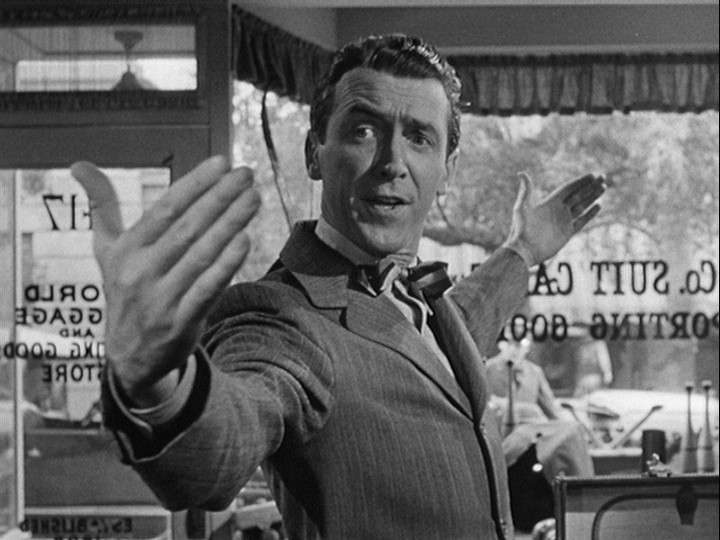 |
| 'Woah. My handshh are huge Mary.' |
Friday, 25 May 2012
Kieran's 50 Favourite Films; No. 49
49. The Long Good Friday
Get Carter has been referred to as the British version of The Godfather, and Layer Cake, the British Goodfellas.
If these comparisons hold up, then I believe that The Long Good Friday is the British Once Upon a Time in America; often forgotten about, but superior to
the rest of its gangster-movie associates. As with the best films, it’s difficult
to articulate why exactly I love Long
Good Friday so. For starters, the performances are sensational, and in some
cases, really quite powerful. Bob Hoskins’ descent into a poisonous mixture of
grief, regret and anger is one of the most chilling transformations in cinema,
and Helen Mirren’s decline from the beautiful and charming trophy-wife into
someone so shell-shocked and anxiety-ridden matches him. The soundtrack, too,
is absolutely incredible, and is instrumental in the build up in tension and
atmosphere which proves to be oh so important in the film making such a
profound impact on the viewer.
In all probability, my obsession with this film
lies in its pacing. The film moves very, very quickly, with numerous scenes of
shocking and unexpectedly brutal violence, and while confusing initially, it
becomes clear that this was the intention. We discover what happens at the same
time as Bob Hoskins’ gangster overlord, creating a far more relatable character
in what is, essentially, an unempathetic scumbag. The sheer scale and
circumstance is perhaps best hinted by the title. The film (mostly) takes place
over a single day. This day, as suggested, by the title, is Good Friday, a day,
of course, associated with the death of Jesus Christ. Hoskins believes himself to be untouchable; 'who would dare attack me!?' But if someone as powerful as Jesus can be defeated, anyone can, after all, he is only human. The choice of this
day in particular is but one of the many uses of examples of black humour used
by director John McKenzie throughout. Just as Jesus dies and has his fall,
Hoskins will have his own; his decline, and he has no choice but to suffer as a
witness to the collapse of his gangland empire around him, suffocating his
pride. I don’t see it as a Christian message, but more of a simple, moral one.
The veil of Hoskins’ hypothetical temple had been rent in two, from top to
bottom. Hoskins has enjoyed his immoral hedonism, and the ending, possibly the
most perfect ending in cinematic history, symbolises him receiving his overdue
justice, in the most delightfully cruel fashion. And it is stunning. One of the
few films which justify the term ‘masterpiece.’
Thursday, 10 May 2012
Kieran's 50 Favourite Films; No. 50
Due to the existence, and
necessity, of exams, I’m afraid I don’t have much time to quench the word lust
of my readers. To atone for the SQA’s wrongdoings, I’ve decided to make up for
this by posting a paragraph or two dedicated to each of my favourite 50 films, counting
downwards, at least until my exams are over, by then my infantile attention
span might drag me to pastures new. But don’t worry, those pastures will be as
smugly sarcastic and narcissistically hate-spewing as ever. I’ll probably post
one every other day, so keep a look out. Okay, are you ready? We’re off...
50. Raiders of the Lost
Ark
Spielberg’s 2nd
greatest filmic achievement, (I say filmic, he might consider being a father
his greatest achievement. Well, the man does enjoy his corniness) it’s very
probably the best adventure film ever made. The adventure ‘genre’ is actually
very particular, contrary to popular belief. The three components of this ‘genre’
consist of two major genres, and one sub-genre in their own right; comedy,
action and romance. Other examples of this delicately defined field range from The Mummy to Pirates of the Caribbean. Raiders
succeeds, where many others fail, because it absolutely nails each individual
component, and they flow and interact seamlessly with one another. The comedy
is light-hearted and genuinely funny, the action frequent and exciting, but
never intrusive, and the romance unashamedly old-fashioned, (maybe a bit
sexist, though) taking the form of the classic ‘reluctant damsel-in-distress
eventually falls for Mr. Charismatic Sarcasm’. It has heroes and villains,
romantic interests and comic relief characters, all staples of adventure. There
are so many great scenes, which are now eternally branded onto the pop culture
cattle; the rolling boulder, the fist fight at the aeroplane, the scene where he
shoots crazy-sword-Arab-man, and, of course, that retreating shot of the Ark’s
final home...
 |
| Here's Indy doing the Haka to impress a statue head. |
I could go on and on about how innovative the special effects
where, or how perfectly atmospheric John Williams’ score was, or how superb the
pacing and characterisation was. Instead, I’ll lastly point out that Raiders is the pinnacle of escapism in
film. We watch films for a variety of reasons; entertainment, education,
attractive actresses in inappropriate clothing, but they are all a product of
escapism; the idea that we can leave the drudgery of our own lives behind, and
embrace another world; an immersive experience. Spielberg achieves the finest
example of escapism with Raiders, in
its purest, most unspoilt form. A blockbuster masterpiece. I leave you with the
words of the greatest film critic of all time, Roger Ebert. He writes ‘It’s
actually more than a movie; it’s a catalogue of adventure... it wants only to
entertain. It succeeds.’[1]
Subscribe to:
Posts (Atom)